
Prepare for Kitesurfing – Learn Faster, Spend Less
Getting into kitesurfing doesn’t have to be overwhelming or expensive. With a bit of preparation, you can fast-track your progress and make the most of every lesson. In this guide, I’ll share the most valuable tips I’ve learned over 12 years of teaching kitesurfing. You’ll get an overview of the sport, understand how lessons are structured, and discover exercises you can do at home to build muscle memory and hit the water with confidence.
How a Lesson is Structured :
Most kite schools around the world follow a similar three-step approach
Step 1 – Kite Control on Land or Shallow Water
You’ll begin by learning how to handle the kite safely. Your instructor will give you a low-power kite so you can get used to the wind and how the kite reacts without stress or risk.
Step 2 – Body Drags in the Water
Once you’re comfortable with the kite, it’s time to head into deeper water. You won’t use the board yet. Instead, you’ll learn how to let the kite pull you through the water (called body dragging), while working on control, balance, and essential safety skills.


Step 3 – Water Starts with the Board
This is the exciting part: riding! You’ll combine everything you’ve learned so far to attempt your first water starts with the board. It’s common to fall a few times, but with each try, you’ll get closer to standing and riding confidently.

Common Challenges Beginners Face
Each of the three learning phases brings its own set of challenges. By identifying them ahead of time and preparing the right way, you can dramatically speed up your progress and feel more confident during your lessons.

Step 1 – Mastering Kite Control
Flying a kite for the first time feels exciting and a bit weird! Almost everyone makes the same mistake: pulling too hard on the bar. It’s an instinctive reaction ,your brain says “pull back” when the kite pulls you. But in kitesurfing, strentgh comes from your harness, not your arms. So instead of fighting the kite, lean back slightly, keep your arms relaxed, and guide the kite gently. The smoother your movements, the better your control will be.

Step 2 – Feeling Safe in Deep Water
This stage can be tricky for some. While many people feel comfortable in the water, others may experience anxiety when moving away from shore. First, let’s be clear: your instructor will be there to guarantee you have a safe experience and will even accompany you in the water if needed, and you’ll be wearing a flotation vest. Still, fear isn’t always logical. If you’re nervous about deep water, try easing into it with swimming or water activities before your lessons. Gaining comfort in the water at your own pace will make a big difference in your ability to focus and progress during the lessons.

Step 3 – Getting Up on the Board
This is where your body control starts to really matter. While kite control and water confidence are essential, physical condition plays a big role in how quickly you’ll manage your first successful rides. You don’t need to be an athlete, but building some strength, balance, and endurance ahead of time can help a lot. Later in this guide, we’ll explore simple home exercises that will prepare your body and help you progress faster.
Understanding the Basics – Wind, Power & Equipment
The Wind Window – Where Your Kite Flies
How does a kite fly ? When you pilot your kite it will move above your head and on the sides , all this area in which the kite moves is called the Wind Window. To describe the kite’s position clearly, we use clock positions: when the kite is directly above your head, it's at 12 o’clock. Move it slightly to the right and it's at 1, then 2, and 3 o’clock when it’s fully to your right. The same applies to the left side, with 11, 10, and 9 o’clock. Learning to visualize these points will help you understand instructions faster and feel more in control both during your lessons and after.
-The size of your kite is measured in square meters , on the side of each kite you will see a number that indicates the size . The bigger the kite the more power it generates . Your instructor will chose a kite size for you depending on your weight , your current level and the wind strength .
- Wind Strength is measured in knots (or km/h, mph, or m/s), stronger winds = more power.
- Your Control: Gentle kite movements lead to smoother, easier handling. Quick or aggressive steering can generate more pull .

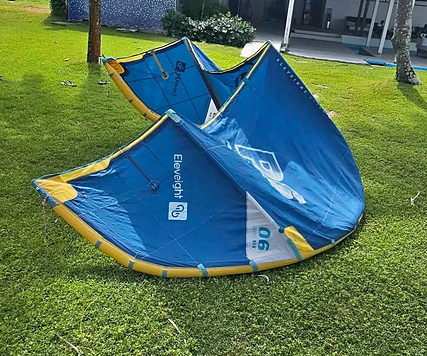

Your Kite Equipment
Let’s break down the main gear you’ll be using :

- The Bar: Your control system. Pull on the left to steer to the left , pull on the right to steer to the right. You can also power and depower the kite by sliding the bare close to you or away from you Pulling it closer increases power; pushing it away reduces it.


- The Lines: These connect your bar to the kite (usually 22–24 meters). Beginners start with shorter lines for safety. Important: never touch the lines while the kite is flying , they are under tension and could cause an injury.
- The Kite: Comes in various sizes (4 – 24m²) and are designed with safety in mind. Today’s kites are easy to relaunch, fully depower at the push of a button, and perform well in a wide range of conditions.
- The Harness: Worn around your waist, it connects to your bar and helps transfer the kite’s power to your body ,not your arms.
- The Board: Most kiters use a twin tip board, those boards are very versatile and allow you to do pretty much everything , that's the board you will be using during your lessons. Boards vary in size and come with footstraps for comfort and control.
Choosing the Right Conditions – Set Yourself Up for Success
Not all kite spots are the same. Some are ideal for beginners, others better suited for advanced riders, and some can accommodate both. Choosing the right location and conditions can make a huge difference in how fast and how easily you will progress.
Wind – The Engine of Your Kite
To learn efficiently, you need wind that’s strong enough to power your kite but not too strong to make things overwhelming.
Ideal wind range:
- 15–25 knots
At around 15 knots, you’ll see small white caps forming on the water a great indicator that conditions are good. Over 25 knots, you might notice sand flying on the beach—that’s a sign the wind is getting strong for beginners. Staying within this range ensures a smooth and manageable learning experience.

I know this photo doesn't match the text but it looks so cool I had to put it somewhere !
Water Conditions – Flatter is Better
When you’re learning, flat water is your best friend. Waves can make it harder to keep your balance on the board. Look for locations calm water, it will help you focus on your technique, stay relaxed, and build confidence much faster.

Learn to pilot a kite before your Lessons – Safely build skills from home
Yes, you can start learning to control a kite even before taking your first lesson and it’s perfectly safe! All you need is a trainer kite, a small, simplified version of the kites used in the water.
Why use a trainer kite?
Low power, high safety: Trainer kites usually range from 1 to 4 square meters and generate very little power, so they won’t pull you off your feet. You’ll safely develop your reflexes and gain the muscle memory needed for real kite control. (Tip: You can also reduce the power even further by folding the lines in half.)
Much cheaper than full size kites, trainer kites are affordable . And once you're done, you can sell it back on any online market place .
Crash-proof: These kites are made entirely from fabric with no rigid structure, making them resistant to impacts. Don’t worry if you crash it—it’s built for that.
.jpg)
How to Practice with Your Trainer Kite
Find a safe, open space like a beach, field, or park with minimal obstacles. The more open the space, the easier and smoother your session will be.
Before flying, it’s essential to understand two key terms you’ll hear constantly in kiting:
- Upwind: The direction the wind is coming from. If the wind is blowing in your face, you're facing upwind.
- Downwind: The direction the wind is going to. If the wind is at your back, you're looking downwind.
Choosing the Right Spot
Avoid standing too close upwind or downwind from large obstacles (trees, buildings, etc.), as they create wind turbulence that makes kite handling harder. The taller the object, the farther away you should be.
How to Fly a Trainer Kite
Trainer kites are intuitive and fun to use, but learning the right technique early on will make your practice much more effective.
Grip and Positioning
Most trainer kite bars are color-coded red indicates the left side. When gripping the bar, keep your hands apart but not too wide. A good rule: you should be able to touch your thumbs together when extended. This gives you balance and fine control.
Start Simple
Begin by flying the kite gently across the wind window from side to side. Don’t worry about being perfect just focus on understanding how the kite responds to your input.
Once you’re comfortable, try these progression exercises:
- Kite clock control: Park the kite at each “hour” on the wind window (e.g., 11, 12, 1) and hold it steady for 10 seconds.
- Walk & fly: Walk around while keeping the kite stable.
- No-look control: Try flying the kite while looking away , this will help you greatly later as you won't have to look at your kite while riding and you will be able to focus more on your stance , other kiters ect...
- One-hand flying: Control the kite with just one hand. If the kite is on the right, use your left hand, and vice versa.
Make sure to connect the safety leash on your wrist and let go the bar if you feel like the kite starts pulling too much
Launching the Kite
Lay the kite flat on the ground with the air inlets (openings) facing downwind. Place a some sand or any litle object with some weight on upwind part of the kite to hold it in place. Walk upwind while unrolling the lines. Then, give a few firm tugs on the bar ,the kite should lift smoothly into the air.
You can also ask a friend to hold the kite at 9 or 3 O clock and gently pull on your upper hand to bring your kite up in the air ( that is the method you will use later on with big kites )
Landing the Kite
There are two safe ways to land:
1. With help: Steer the kite close to the ground and have a friend grab it.
2. Solo: Simply let go of the bar. Your safety leash, attached to your wrist, will catch the kite and let it drop safely.
Pro tip:
Every hour you spend with a trainer kite builds reflexes and confidence. When you move on to a full-size kite, you’ll learn faster, ride sooner, and save money on lessons. Totally worth it!
Improve Your Body Control and Balance
Once you’ve started working on your kite control, the next step is to train your body. Good balance and coordination are key to progressing faster and riding more confidently. Here are three easy and accessible ways to prepare from home:
• Balance Board
This simple tool is one of the best ways to improve your stability especially if you’ve never done board sports before. It simulates the feeling of being on a kiteboard and helps train your legs and core.
Pro tip: Start on soft surfaces like grass or sand. If you're indoors, create a safe setup with cushions or yoga mats around you to avoid injury in case you fall.
• Slackline
A slackline challenges your balance and body awareness like nothing else. It strengthens your core, boosts focus, and teaches you to make quick micro-adjustments just like you’ll need on the water. Plus, it’s a fun challenge you can do in your backyard or a park.
• Yoga
Yoga is the ultimate all-rounder. It improves flexibility, strengthens every muscle group, and helps you stay relaxed and focused ,especially useful when learning something new like kitesurfing. Whether you take a local class or follow a video at home, just 15–20 minutes a few times a week can make a big difference.
Low-cost, high value
These 3 activities are affordable, can be done almost anywhere, and deliver great results both physically and mentally. Investing a bit of time in them now will accelerate your learning once you hit the water.
Build Confidence in the Water
Feeling at ease in the water is essential for a smooth kitesurfing progression. The more relaxed and confident you are, the faster you’ll learn—and the more fun you’ll have doing it. If deep water feels intimidating right now, no worries! Here are a few simple activities to help you gain confidence at your own pace:
• Swimming Pool Sessions
Pools are a great place to start. You can gradually increase your comfort zone: begin in shallow water, then try swimming in deeper sections. Challenge yourself to swim for 1, 2, 5, or even 10 minutes without stopping. Go at your own pace ,you set the limits.
• Ocean Swimming (Shallow Water)
The open sea can feel a bit overwhelming at first, but there’s no rush. Start in shallow water where your feet can still touch the ground. This gives you a safety net you can stand up any time. Move on to deep water when you feel ready and challenge yourself to swim further or stay longer at your own pace . Pick a calm beach with little to no waves for the most comfortable experience.
• Stand-Up Paddleboarding (SUP)
SUP is one of the best ways to get used to being on the water. It improves your balance and builds trust in your ability to handle yourself. If standing up is tricky at first, no problem start by paddling from your knees and work your way up.

.jpg)

